
Key Takeaways
- Nearsightedness makes distant objects look blurry, while farsightedness makes close-up objects harder to see.
- Both happen when light focuses in the wrong spot inside your eye.
- Astigmatism and presbyopia are two other refractive errors that affect focus.
- Glasses, contact lenses, and regular eye exams can help you see clearly again.
What Nearsighted & Farsighted Mean
Maybe you reach for your phone and the words look sharp, but the street sign down the block is a blur. Or maybe the opposite happens, and the menu across the room reads fine while the fine print on the table in front of you is fuzzy. Both situations point to a refractive error, and both are common reasons why our patients at See and Co book an eye exam with us.
Nearsightedness means that distant objects look blurry, while close up objects stay clear. Farsightedness means that close-up objects look blurry, while distant objects are clear. Both happen when your eyes focus light incorrectly.
Nearsighted Vision Explained
How Nearsightedness Happens
Nearsightedness, also called myopia, shows up when your eyeball grows a little too long or your cornea (the front of your eye) curves too steeply. This causes light to focus in front of the retina (a tissue at the back of your eye) rather than on it, making far-away objects look blurry. Nearsightedness often starts in school-age kids, and it tends to progress as they grow.
Signs of Nearsightedness
Common symptoms of nearsightedness include:
- Distant objects like road signs or a whiteboard look blurry.
- You squint to bring far-away things into focus.
- Headaches or eye strain follow long stretches of trying to see distance.
Farsighted Vision Explained
How Farsightedness Happens
Farsightedness, or hyperopia, works the other way around. In people with farsightedness, the eyeball is a bit too short or the cornea is too flat, so light focuses behind the retina, causing close-up objects to become blurry. Many people are born with nearsightedness, but younger eyes can often compensate.
Signs of Farsightedness
Symptoms of farsightedness include:
- Close objects like a phone screen look blurry.
- Your eyes fatigue quickly when you focus on near tasks.
- Headaches and other discomfort after doing close work.

Key Differences & Other Refractive Errors
Nearsightedness vs. Farsightedness at a Glance
Here is the simplest way to keep the two straight.
- Nearsighted means distance looks blurry.
- Farsighted means close-up looks blurry.
That’s the core of the distinction, and the only thing that you really need to know.
Astigmatism & Presbyopia
Nearsightedness and farsightedness aren’t the only common refractive errors. Astigmatism is caused by an uneven curve in the cornea or lens and causes blurry vision at all distances. Presbyopia is age-related, usually appearing after 40, and happens when the lens of the eye starts to stiffen, making tasks like reading harder.
You can have both of these alongside nearsightedness or farsightedness.
Ways to Correct Your Vision
Both nearsightedness and farsightedness can be corrected. Glasses are the most common option, but many people find contact lenses convenient. If you spend a lot of time in front of screens, ZEISS computer lenses can help ease the tired, strained feeling that builds up by afternoon.
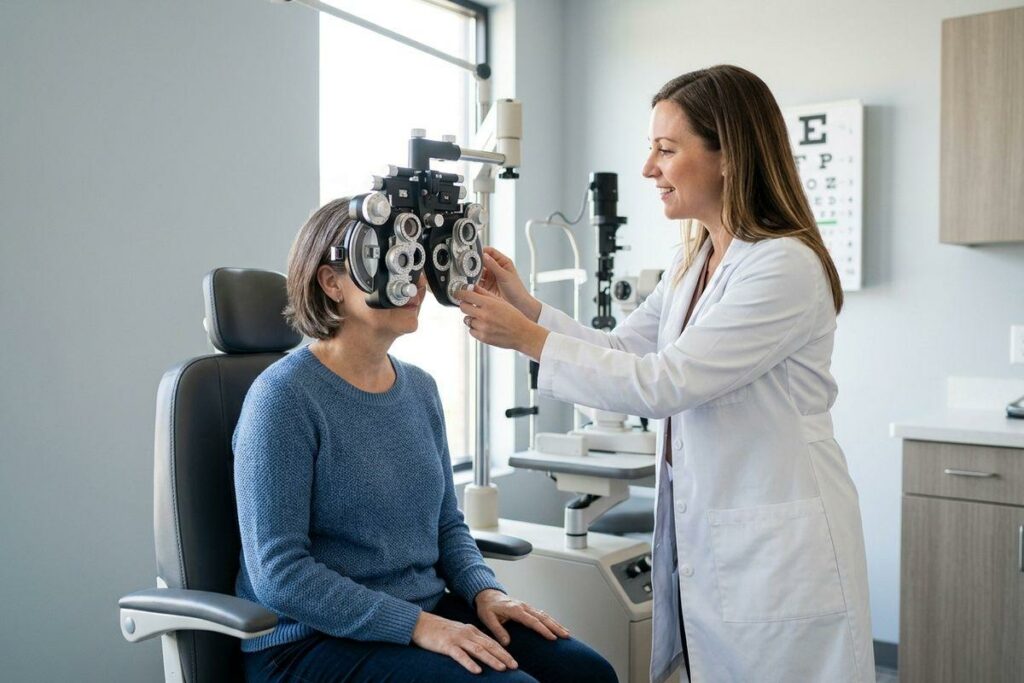
If distant signs or fine print have been giving you trouble, our team at See and Co can walk you through your options and find a fit for your daily routine. As your optometrist in Centreville, VA, we take the time to explain what your eyes need. Book your appointment today and see the difference clearer vision can make.